WHY CREATIVITY REQUIRES DISCIPLINE TO SCALE.
Why creativity does not scale without discipline
Most brands believe creativity can scale naturally. It cannot.
In fashion and luxury, creativity is often protected as a talent to be preserved. In reality, it is a function that must be governed.
As scale increases — more products, more teams, more markets — undisciplined creativity ceases to be a competitive advantage. It becomes a structural source of complexity, inconsistency and margin pressure.
The core issue: creativity without ownership.
In many fashion and luxury organisations, creative direction occupies an ambiguous space: culturally protected, emotionally charged, but operationally undefined.
The result is systemic: collections lose coherence season after season; brand codes shift unintentionally; teams interpret direction inconsistently; commercial functions are forced to compensate through discounting and complexity.
Why creative discipline drives performance.
Market evidence points to a structural transformation of luxury. According to BCG–Altagamma True Luxury Global Consumer Insights 2025, value growth is increasingly driven by top-tier segments: less sensitive to macroeconomic volatility and more demanding in terms of coherence, quality and execution.
Value is no longer a function of volume. It is a function of brand system credibility.
Top-tier clients — an elite representing approximately 0.1% of global consumers — generate around 37% of total luxury market value, including capital-intensive categories such as luxury automotive, yachts and private aviation.
This fundamentally reshapes competitive logic: value is highly concentrated; expectations are elevated; inconsistency is not tolerated. In these segments, excellence is the outcome of disciplined, governed systems built over time.
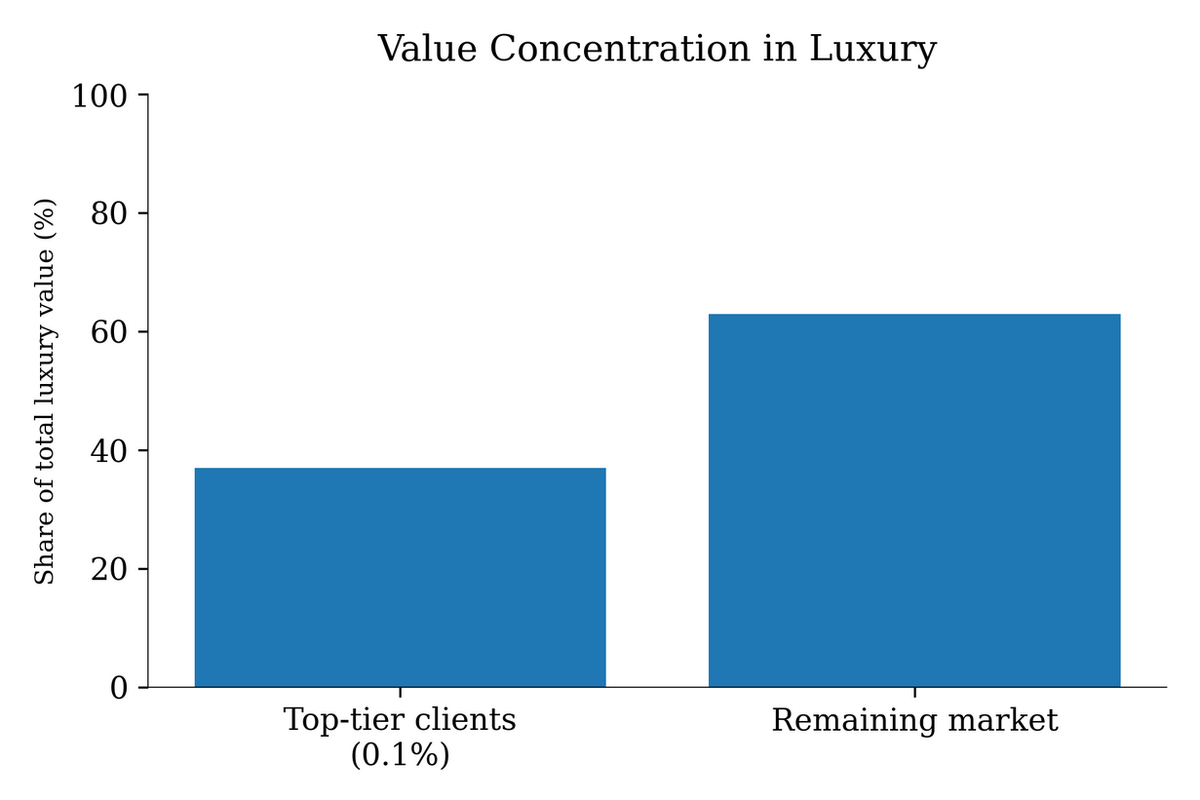
For top-tier clients, incoherent creativity is not an aesthetic risk — it is a reason for exclusion. Every ungoverned creative deviation erodes trust; every misalignment between creative direction, product and execution is perceived; every downstream compromise directly impacts margins and economic resilience.
The Creative Governance Triangle.
Brands that scale sustainably treat creative direction as a strategic discipline. The operating model rests on three pillars.
Brand Codes
Non-negotiable aesthetic principles, product DNA and visual language.
Decision Rights
Who defines direction, who validates, who has the authority to say no.
Decision Gates
Structured validation moments against explicit criteria.

Field evidence: creative drift during scale-up.
In a high-end brand undergoing growth, increasing SKUs and channels progressively eroded collection coherence. Creative direction was strong, but based on informal alignment.
The absence of clear decision gates resulted in variants unsupported by product architecture, continuous rework and margin pressure.
The introduction of formalised brand codes and an Architecture sign-off gate restored control, reduced complexity and protected margins.
Core decision gates.
Creativity is not debated continuously. It is validated at specific moments, against shared criteria.
Architecture sign-off
Coherence · margin · scalability
Prototype & fit approval
Quality · construction · industrial feasibility
Collection freeze
Pricing · margin integrity · market readiness
Go-to-market release
Channel · timing · execution risk

In contemporary luxury, competition is no longer about isolated novelty, but about the ability to sustain a credible value promise over time. Ungoverned creativity does not fail immediately. It is simply excluded from the segments that generate value.
Structure turns judgement into repeatable authority.
For selected engagements, Virgili Studio works as an executive operating partner across brand governance, product systems and execution.
ENTER EXECUTIVE ASSESSMENT →